Theodore von Kármán
1881–1963 · Budapest
Hungarian-American aerodynamicist; the Kármán line marking outer space bears his name
1 stamps · 0 countries
One life, many countries
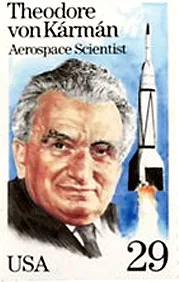 —Unknown issuer
Theodore von Kármán was born in Budapest in 1881 into a Jewish family. Trained as an engineer and mathematician, he became one of the founders of modern aeronautics, first in Germany, where he led the aeronautical institute in Aachen, and from the 1930s in the United States, where he directed the Guggenheim aeronautical laboratory at Caltech. His studies of supersonic and hypersonic airflow helped open the age of jet aircraft and rockets, and he played a leading part in creating the Jet Propulsion Laboratory. He is widely regarded as the outstanding aerodynamic theorist of the twentieth century. The altitude at which the atmosphere is said to end and outer space to begin is called the Kármán line in his honour. A member of the US National Academy of Sciences and a foreign member of the Royal Society, he died in Aachen in 1963.
Facts checked against Wikipedia ↗